第 2 章 算法分析
Algorithm Analysis
算法分析引入
假设有两个程序都能正确完成同一个任务。
输入只有 100 个元素时:
- 程序 A:0.2 ms
- 程序 B:0.3 ms
几乎没有区别。
但如果 A 的工作量大约随 \(n^2\) 增长,而 B 大约随 \(n\log n\) 增长,当输入扩大到 100 万时,两者可能从“都很快”变成“一个还能运行,另一个几乎不可用”。
在真正运行大规模输入之前,能不能从代码结构本身预测这种差距?
规模放大会暴露很多不同的成本问题
- 查找:顺序查找(sequential search)和二分查找(binary search)在小数组上都很快,规模扩大后差距明显
- 排序:二次增长与“接近线性但多一个对数因子”的增长,在数据量上升时会进入完全不同的区间
- Transformer 注意力机制:序列长度增大时,标准自注意力的计算和显存成本会快速增长
- 智能体工作流:搜索分支数和最大深度增加时,工具调用与模型调用的总成本可能迅速放大
因此算法分析要建立一套不依赖某台机器、能够解释规模变化的成本模型(cost model)。
本章将从时间与空间、基本操作(basic operation)计数、最好情况(best case)/最坏情况(worst case)/平均情况(average case)出发,再用渐进记号(asymptotic notation)把具体计数提升为可比较的增长率。
本章路线图
学习目标
完成本章后,应能回答:
- 性能分析和性能测量有什么区别
- 空间复杂度(space complexity)由哪些部分组成
- 如何选择基本操作并计算执行次数
- 如何分析顺序查找的最好、最坏和平均情况
- 为什么选择排序(selection sort)、冒泡排序(bubble sort)、排名排序(rank sort)的比较次数都是二次级
- 插入排序(insertion sort)为什么最好线性、最坏二次
- \(O\)、\(\Omega\)、\(\Theta\) 三种渐进记号分别表达什么
- 二分查找为什么是对数级
- 最大子段和问题如何从三次增长改进到二次增长,再改进到“线性 × 对数”增长
- 辗转相除法为什么是对数级
成本模型
性能分析与性能测量
确定算法成本有两种互补方法:
- 性能分析:在运行前,根据代码和数学模型推导时间、空间复杂度
- 性能测量:实际运行程序,记录时间、内存、缓存、分支预测等表现
性能分析给出增长趋势。
性能测量反映具体机器、编译器、输入分布和实现细节。
课程中先学习分析,因为它能解释“为什么规模一大,某些程序突然不可用”。
工程连接:开源库为什么重视复杂度
复杂度分析会直接影响工程库的接口和实现选择。
 Java 标准库 Java
 Arrays.sort / Collections.sort 的库实现会用工程化策略避免朴素快速排序(quicksort)的常见退化
 Python Timsort 利用已有有序片段降低实际成本
 PostgreSQL 查询优化器估算排序、连接和扫描代价
Linux 调度和内存管理需要可预期的最坏成本
算法分析给出增长趋势,工程测量再检查缓存、分支预测、内存分配和输入分布带来的常数差异。
时间与空间
程序总时间可以粗略写成:
\[
T(p)=T_{\text{compile}}+T_{\text{run}}
\]
编译时间通常不依赖本次输入规模;算法分析主要关心运行时间随实例特征变化的规律。
空间复杂度关注程序运行到结束所需内存。它同样随输入规模变化。
空间复杂度的组成
空间可以分成三类:
- 指令空间:程序代码本身
- 数据空间:常量、简单变量、数组、对象、动态分配空间
- 环境栈空间:保存尚未完成的函数调用信息
更常用的分析方式:
- 固定部分:与输入规模无关
- 可变部分:数组、动态空间、递归调用栈等随规模变化的空间
空间例子:顺序查找
sequentialSearch(…) 从左到右寻找目标并返回命中位置;在命中前,已扫描前缀都可确定不含目标。
i;候选逐个被排除,不需要随数组长度增长的辅助存储。
-1;除输入外始终只占常数个标量,因此辅助空间是常数级,不会随数组长度增长。
空间例子:递归求和
recursiveSum(…) 返回给定前缀的总和;递归每层只负责把一个元素并入更小前缀的结果。
n 是当前前缀长度;先限制到合法范围,递归规模才不会越过数组边界。
n 同步增长,所以递归栈空间是线性增长。
操作计数
时间复杂度(time complexity):基本操作计数
时间分析通常分三步:
- 选择一个能代表主要成本的基本操作
- 数出它随输入规模执行多少次
- 用精确次数或自然语言描述它随输入规模的增长趋势
基本操作可以是:
- 基本运算
- 四则运算
- 比较
- 布尔运算
- 内存读写
- 数组访问
- 指针解引用
- 程序计数器跳转
- 函数调用
- 分支/循环
求最大元素位置
问题描述
给定一个非空数组,返回其中最大元素所在的下标。
例如输入 [8, 25, 16, 30],答案应为下标 3。
思路分析
维护一个变量 pos,表示“到目前为止见过的最大元素位置”。从左向右扫描,每遇到更大的元素就更新 pos。
关键操作是比较 a[pos] < a[i]。长度为 \(n\) 时恰好比较 \(n-1\) 次,因此是线性增长。
求最大元素位置
求最大元素位置
maxPosition(…) 返回最大元素的位置而不是值;扫描过程中只维护当前最佳下标。
max=0 建立不变量:max 始终指向已扫描前缀中的最大元素;因此扫描从位置 1 开始。
max;每轮结束后,“前缀最大值位置”这一不变量仍然成立。
n-1 个新候选后,前缀就是整个数组,因此 max 是全局最大值位置;比较次数随 n 线性增长。
基本/不基本运算的判断
有些运算并不基本。最突出的例子是哈希函数的计算。
- 在输入不定长、没有上界时,哈希函数本身的开销也没有上界
- 只有输入长度固定时,哈希计算可以被认为是一个基本运算
基本运算的有限组合都可以看做一次基本运算。例如:
- 交换两个变量/内存位置
- 进行一次函数调用,这个函数内部没有循环也没有任何函数调用
选择排序
思路分析
把数组分成“已排序前缀”和“未排序区间”。每一轮扫描未排序区间,记录最小元素的位置,扫描结束后与当前左端交换。
核心不变量是:第 \(i\) 轮结束后,前 \(i+1\) 个位置已经是全局最小的 \(i+1\) 个元素,并且以后不会再改变。
选择排序代码
selectionSort(…) 每轮把未排序区的最小元素放到边界位置,并逐步扩大已确认有序前缀。
i 是本轮要永久确定的位置;进入这一轮时,前缀 [0,i) 已经是全局最小的一批元素。
min 从未排序区间左端起步,内层扫描只负责回答一个问题:这一轮真正的最小值在哪里。
min;扫描结束时它指向整个未排序区间的最小元素。
i,于是已排序前缀增长一格;比较总数累加为 n(n-1)/2。
选择排序:操作次数
第 \(i\) 轮比较 \(n-i-1\) 次,因此总比较次数是 \((n-1)+(n-2)+\cdots+1=\frac{n(n-1)}{2}\)。
交换最多 \(n-1\) 次;若一次交换用三次赋值,元素移动约为 \(3(n-1)\)。
结论:
- 比较:二次增长 —— 主导项是 \(n^2\)
- 移动:线性增长 —— 最多与 \(n\) 成正比
- 因而总运行成本由比较主导,表现为二次增长
冒泡排序
思路分析
从左到右比较相邻元素。如果左边比右边大,就交换它们。较大的元素会像“气泡”一样不断向右移动。
一轮结束后最右端元素已经就位;下一轮可以忽略它,只处理更短的前缀。
冒泡排序代码
bubblePass(…) 完成一趟相邻比较,把当前最大元素推到本趟末端。
n 定义本轮仍需处理的前缀;先校验边界,才能安全把 n-1 当作本轮最终位置。
n-1,下一轮可永久忽略它。
情况分析
最好、最坏与平均
同一段代码在不同输入上可能成本不同。
- 最好情况:最有利输入
- 最坏情况:最不利输入
- 平均情况:按某种输入分布求期望
平均情况通常最难,因为它要求明确“输入如何随机产生”。
课程初期常先分析最好和最坏,再在必要时讨论平均。
顺序查找
问题描述
给定一个数组和目标值 x,返回 x 第一次出现的位置;如果不存在,返回 -1。
数组不要求有序,因此不能依赖大小关系跳过一整段位置。
思路分析
从左到右逐个比较 a[i] 和 x。一旦相等立即返回当前位置;扫描到末尾仍未命中则返回 -1。
这个算法的成本直接由“目标出现在第几个位置”决定。
顺序查找
顺序查找代码
sequentialSearch(…) 从左到右寻找目标并返回命中位置;在命中前,已扫描前缀都可确定不含目标。
n 个位置都必须检查,因此最坏情况的比较次数随 n 线性增长。
1..n 上均匀分布,平均为 (n+1)/2,仍是线性增长。
插入排序
问题描述
给定一个无序数组,把它按从小到大排列。
思路分析
维护一个已排序前缀。取出下一个元素 t,把所有比 t 大的前缀元素向右移动一格,再把 t 放进留下的空位。
核心不变量是:每轮结束后,前缀始终保持有序。
插入排序代码
insertionSort(…) 逐个扩展有序前缀;每次把新元素插入它在前缀中的正确位置。
p 轮时,前缀 [0,p) 已经有序;本轮只需把一个新元素插进去。
tmp 暂存待插入值,j 表示当前“空位”;这样移动前缀元素时不会丢掉待插入值。
tmp 腾位置。
tmp 放入最终空位后,新前缀仍有序;已排序输入几乎不移动,逆序输入则产生二次移动。
插入排序:最好与最坏
最好情况:数组已经有序。
每轮只比较一次,不移动元素;总比较次数与 \(n\) 成正比,因此是线性增长。
最坏情况:数组逆序。
第 \(i\) 轮要移动 \(i\) 个元素:
\[ 1+2+\cdots+(n-1)=\frac{n(n-1)}{2} \]
因此最坏情况下,移动次数的主导项与 \(n^2\) 成正比,属于二次增长。
逐行计步:给每行计算执行次数
有时需要不只数关键操作,而是给所有语句计步。
sum(…) 返回这段循环结构产生的累计结果/执行次数,用来把代码行为转成可计算的复杂度表达式。
total=0 选用加法单位元建立累计不变量:处理过的前缀之和始终保存在 total 中。
n 增长,真正重复的工作正是这一轮更新。
2n+3 还是别的常数形式,主导项都与 n 成正比,因此是线性增长。
渐进增长
渐进符号
渐进符号描述 \(n\) 很大时函数增长的主导趋势。
- \(O(g(n))\):上界,不超过某个常数倍的 \(g(n)\)
- \(\Omega(g(n))\):下界,至少达到某个常数倍的 \(g(n)\)
- \(\Theta(g(n))\):紧确界,上下界都是同一个增长阶
它们忽略常数因子和低阶项,但不忽略增长阶。
\(O\) 记号:上界
定义:
\[
f(n)=O(g(n))
\]
当且仅当存在正常数 \(c\) 和 \(n_0\),使得对所有 \(n\ge n_0\):
\[
f(n)\le c g(n)
\]
例如:
\[
3n+2 \le 4n \quad (n\ge 2)
\]
所以 \(3n+2=O(n)\)。
\(\Omega\) 与 \(\Theta\) 记号
下界:
\[
f(n)=\Omega(g(n))
\]
表示 \(f(n)\) 至少像 \(g(n)\) 那样快地增长。
紧确界:
\[
f(n)=\Theta(g(n))
\]
表示同时存在常数 \(c_1,c_2,n_0\),使得:
\[
c_1g(n)\le f(n)\le c_2g(n)\quad(n\ge n_0)
\]
如果能说 \(\Theta\),就比只说 \(O\) 更精确。
常见增长等级
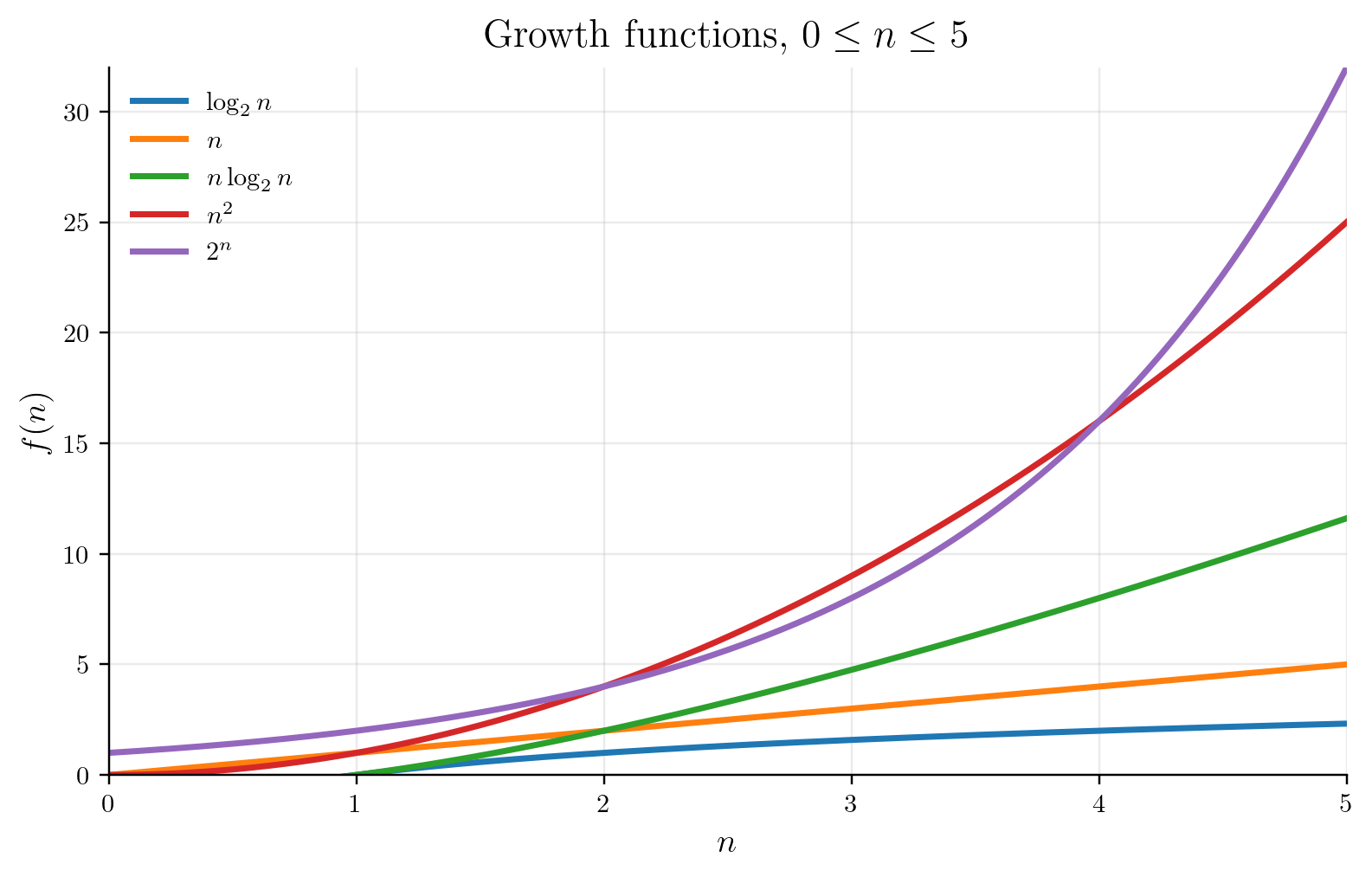
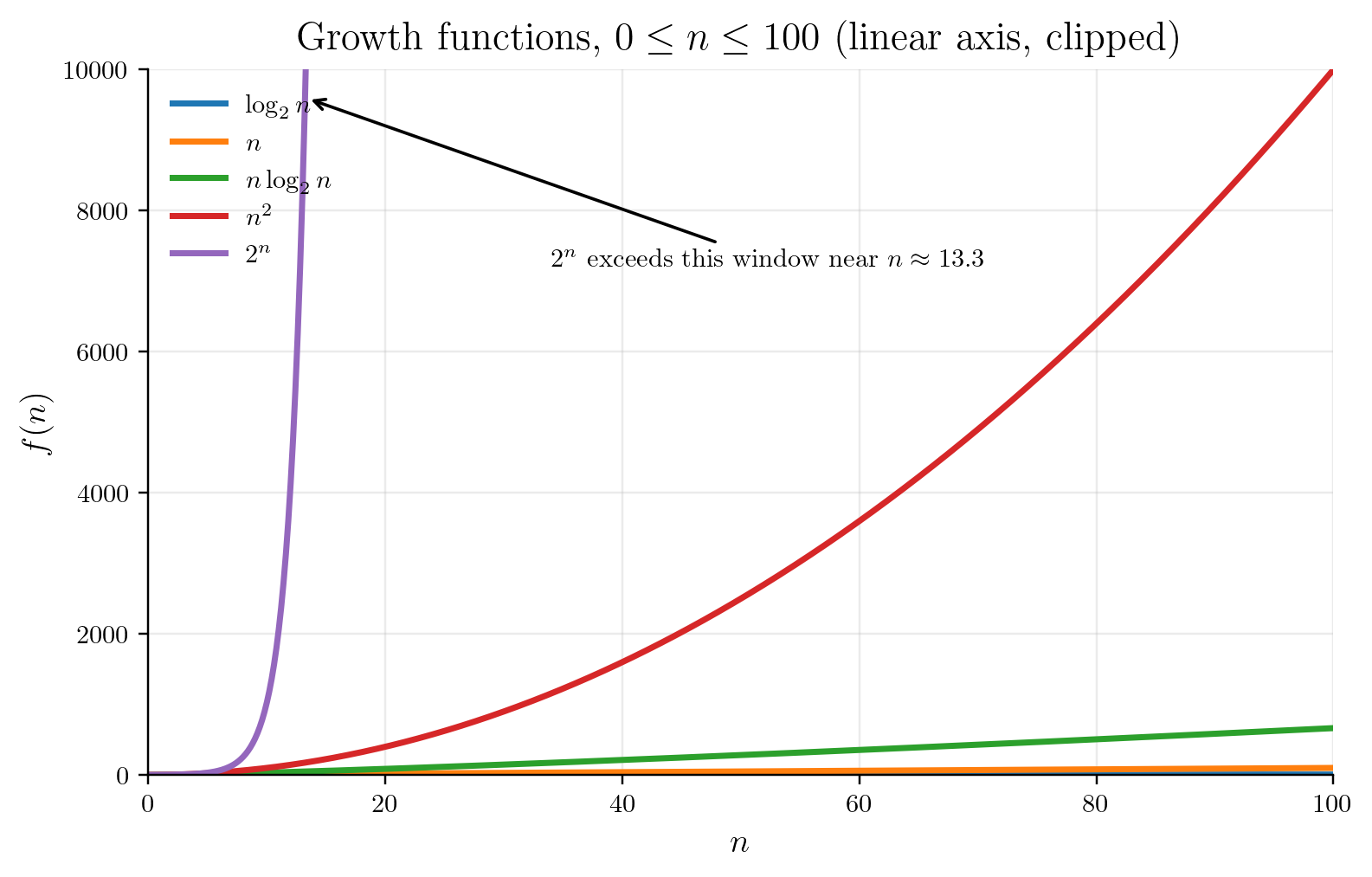
对数算法
二分查找
问题描述
给定一个已经按升序排列的数组和目标值 x,返回 x 所在的位置;如果不存在,返回 -1。
和顺序查找不同,这里可以利用“有序”这一额外条件一次排除大量候选位置。
思路分析
维护候选区间 [low, high],每次检查中点 mid:
a[mid] < x:目标只可能在右半边a[mid] > x:目标只可能在左半边a[mid] == x:直接返回
每轮候选区间大约减半,因此比较轮数是对数级。
二分查找
二分查找代码
[left,right] 初始覆盖整个有序数组;核心不变量是:目标若存在,就一定仍在这个候选区间内。
left≤right,候选区间就还非空;当左右边界交错时,所有位置都已被排除。
left 推到 mid+1,只保留仍可能含有 6 的右半区,不变量继续成立。
right 收到 mid-1,候选集只留下仍可能等于 6 的左侧部分。
-1;每轮至少丢掉约一半候选,所以比较轮数为 O(log n)。
最大子段和
最大子段和
问题描述
给定整数序列 \(a_1,a_2,\ldots,a_n\),允许存在负数,求连续子段的最大和:
\[
\max_{1\le i\le j\le n}\sum_{k=i}^{j}a_k
\]
如果所有数均为负数,这里采用约定:最大子段和为 0。
例子:
\[
[-2,\ 11,\ -4,\ 13,\ -5,\ -2]
\]
最大子段是 \([11,-4,13]\),和为 20。
最大子段和算法1:三层枚举
思路分析
最直接的方法是枚举所有连续子段:第一层选择起点 i,第二层选择终点 j,第三层重新扫描 [i,j] 求和。
它几乎是问题定义的直接翻译,因此最容易验证正确性;代价是大量重复求和。
最大子段和算法1实现
maxSubSum1(…) 返回连续子段的最大和;不同实现只改变候选区间被枚举或合并的方式。
best=0 表示目前允许选择空子段;之后它始终保存已经检查过的区间中的最大和。
i 与 j 枚举所有连续区间的左右端点,因此候选区间本身已经有 Θ(n²) 个。
[i,j] 又从头扫描整段求和;大量区间共享元素却重复计算,这一层把成本推到 O(n³)。
best 比较;循环结束时所有连续区间都已被考虑。
最大子段和算法2:固定起点累加
思路分析
观察算法 1 的重复工作:当终点从 j 扩展到 j+1 时,前面的区间和已经算过,没有必要重新扫描。
因此固定起点 i 后,用 thisSum 从左到右累加;每扩展一个终点只做一次加法。
最大子段和算法2实现
maxSubSum2(…) 返回连续子段的最大和;不同实现只改变候选区间被枚举或合并的方式。
best 仍保存已见区间的最优和;算法改进不改变答案不变量,只改变候选和的计算方式。
i 后把当前和清零;接下来所有候选都从同一个起点向右扩展。
a[j],直接复用上一段的和;这正好删除了算法 1 的整段重复扫描。
Θ(n²);每个候选只做常数工作,整体降为 O(n²)。
best 已覆盖所有连续子段;返回它就是算法 2 的最终答案。
最大子段和算法3:分治
思路分析
把数组分成左右两半。最大子段只可能在三类位置:
- 完全在左半边
- 完全在右半边
- 跨过中点
递归求左右两边,再用线性扫描求跨中点最大和:
从中点向左扫:只保留能贴着中点向左延伸的最大边界和。
从中点向右扫:同理得到右侧最大边界和;两者相加就是“跨中点”候选。
最终的时间复杂度:\(T(n)=2T(n/2)+O(n)\)
因此:\(T(n)=O(n\log n)\)
最大子段和算法3:分治
最大子段和算法3:分治实现
static int maxSubSumDivide(int[] a) {
    if (a.length == 0) {
        return 0;
    }
    return maxSumRec(a, 0, a.length - 1);
}

static int maxSumRec(int[] a, int left, int right) {
    if (left < 0 || right >= a.length || left > right) {
        throw new IllegalArgumentException("invalid subarray range");
    }
    if (left == right) {
        return Math.max(a[left], 0);
    }
    int center = left + (right - left) / 2;
    int maxLeftSum = maxSumRec(a, left, center);
    int maxRightSum = maxSumRec(a, center + 1, right);

    int maxLeftBorderSum = 0;
    int leftBorderSum = 0;
    for (int i = center; i >= left; i--) {
        leftBorderSum += a[i];
        maxLeftBorderSum = Math.max(maxLeftBorderSum, leftBorderSum);
    }

    int maxRightBorderSum = 0;
    int rightBorderSum = 0;
    for (int i = center + 1; i <= right; i++) {
        rightBorderSum += a[i];
        maxRightBorderSum = Math.max(maxRightBorderSum, rightBorderSum);
    }

    return Math.max(Math.max(maxLeftSum, maxRightSum), maxLeftBorderSum + maxRightBorderSum);
}
maxSubSumDivide(…) 返回连续子段的最大和;不同实现只改变候选区间被枚举或合并的方式。
maxSumRec(…) 返回连续子段的最大和;不同实现只改变候选区间被枚举或合并的方式。
O(n),故 T(n)=2T(n/2)+O(n)=O(n log n)。
最大子段和:三种算法对照
- 明确输入与目标:允许负数,空子段和按 0 处理。
- 三层枚举:先选起点 i=1。
- 再选终点 j=3。
- 第三层重新求和,得到 11 + (-4) + 13 = 20。
- 改进一:固定 i 后向右累加,不再每次从头求和。
- 累加到 j=1:当前和为 11。
- 累加到 j=2:当前和为 7。
- 累加到 j=3:当前和为 20,刷新最好答案。
- 改进二:分治把数组分成左右两半。
- 最优子段可能完全在左半边。
- 也可能完全在右半边。
- 还可能跨过中点;本例最优跨中点。
- 三种思路比较:O(n³)、O(n²)、O(n log n),还能继续优化到 O(n)。
Kadane算法:先只观察
从左到右看:每个前缀 \(0\ldots i\) 里,最大子段和是多少?
- 单独的负数前缀:舍弃。
- 一段累加到 \(<0\):不要再接到后面。
- 最优子段里出现负数:至少一侧的和要能抵消它。
Kadane算法:把观察变成状态
endHere = max(0, endHere + a[i])
bestSoFar = max(bestSoFar, endHere)
一遍扫描:\(O(n)\) 时间,\(O(1)\) 空间。
辗转相除法(欧几里得算法)
问题描述
给定两个正整数 \(m\) 和 \(n\),求它们的最大公因数 \(\gcd(m,n)\)。
直接枚举所有可能的公因数当然可以,但如果数很大,逐个尝试会非常慢。我们希望利用数本身的结构快速缩小问题规模。
例如:
\(\gcd(50,15)=5\)
关键问题是:怎样把 \((50,15)\) 转换成一个更小、但答案完全相同的问题?
辗转相除法
思路分析
设 \(g=\gcd(m,n)\),则 \(m=k_mg,\ n=k_ng\)。
任意做整数次减法都有
\(m-qn=(k_m-qk_n)g\)
所以减法不会改变最大公约数。
连续减很多次可压缩成一次取余。设\(m>n\):
\(gcd(m,n) == gcd(n,m\bmod n)\)
而且 \(0\le m\bmod n<n\),因此每一步都会把数缩小,过程一定在余数变成 0 时结束。
辗转相除法
gcd(m,n) 的状态变换。
gcd(m,n) 不变;只要 n≠0,就把问题改写成答案相同但规模更小的一对数。
50%15=5 给出下一轮唯一需要的新信息;由 gcd(m,n)=gcd(n,m%n),丢掉商不会损失答案。
gcd(15,5)。
n;这个单调缩小保证过程最终会停。
n=0 使下一次循环检查失败;终止状态被规范成 (g,0) 的形式。
gcd(g,0)=g;这正把“何时停”与“停下时为什么正确”连在一起。
m 即得到原问题答案;全程只维护两个数和一个余数,辅助空间为常数级。
辗转相除法:复杂度分析
设 \(m\ge n>0\)。一轮把 \((m,n)\) 变成 \((n,\ m\bmod n)\)。
为什么规模会很快缩小?只需分两种情况:
- 若 \(n\le m/2\),一轮后较大的参数已经不超过 \(m/2\)。
- 若 \(n>m/2\),则 \(m\bmod n=m-n<m/2\);再做一轮后,两个参数都会小于 \(m/2\)。
因此,至多两轮,较大的参数至少减半。每减半一次只需常数轮,所以迭代次数是
\(T(m,n)=O(\log \min(m,n))\)。
辗转相除法:确实会达到 \(\log n\)
连续 Fibonacci 数正好让余数下降得最慢。例如:
\((21,13)\rightarrow(13,8)\rightarrow(8,5)\rightarrow(5,3)\rightarrow(3,2)\rightarrow(2,1)\rightarrow(1,0)\)
每次只下降一个 Fibonacci 层级。一般地,输入 \((F_{k+1},F_k)\) 时需要约 \(k\) 次取模,而
\(F_k\approx \frac{\varphi^k}{\sqrt5}\),因此 \(k=\Theta(\log F_k)\)。
所以辗转相除法确实需要 \(\Theta(\log n)\) 次迭代。
辗转相除法:时间和空间复杂度
前面的 \(\Theta(\log n)\) 只是取模次数,不是计算复杂度。m % n 不能算一个基本操作。
设输入长度是 \(L_m,L_n\),且 \(L_m\ge L_n\)。
那么首次长整数取余的竖式计算步数为 \(L_m-L_n+1\),每步的读写是 \(L_n\),总共是
\[ O\bigl(L_n(L_m-L_n+1)\bigr), \]
关于输入长度是平方的。
只需要保留计算过程中的余数,辅助空间是 \(O(L_n)\)。
以上是一次迭代。多次迭代的结果是?
辗转相除法:时间和空间复杂度
设连续各个数的长度为 \(L_0=L_m, L_1=L_n, L_2,\ldots\),且 \(L_0\ge L_1\ge L_2\ge\cdots\)。
第 \(i\) 次取余的时间为 \(O\bigl(L_{i+1}(L_i-L_{i+1}+1)\bigr)\),所以总时间为 \(T=\sum_i O\bigl(L_{i+1}(L_i-L_{i+1}+1)\bigr)\)。
又因为每个后续数都不比 \(n\) 更长,即 \(L_{i+1}\le L_n\),因此 \(T\le O\left(L_n\sum_i(L_i-L_{i+1}+1)\right)\)。
辗转相除法:时间和空间复杂度
\(T\le O\left(L_n\sum_i (L_i-L_{i+1}+1)\right).\)
其中长度差会折叠:\(\sum_i(L_i-L_{i+1})=L_m-L_{last}=O(L_m).\)
因此 \(T=O\bigl(L_n(L_m+L_n)\bigr).\)
由于 \(L_m\ge L_n\),\(\boxed{T=O(L_mL_n)}.\)
再详细分析Fibonacci型输入,最坏情况下确实可以达到\(\boxed{\Theta(L^2)}.\)
辅助空间方面,迭代过程中只需要保存当前两个数和余数;若不计输入本身,辅助空间为\(\boxed{O(L_n)}.\)
本章小结
- 性能测量回答“这台机器上跑了多久”,性能分析回答“规模增长时成本怎样变化”。
- 空间复杂度要区分输入存储、固定变量、辅助数组以及递归调用栈。
- 基本操作应选取最能代表主导成本的语句,再用循环、嵌套和递归关系计算执行次数。
- 顺序查找的成本随目标位置变化,因此最好、最坏和平均情况必须分开讨论。
- 选择排序、冒泡排序和排名排序都包含成对比较或双层扫描,比较次数属于二次级。
- 插入排序利用已有有序性;输入接近有序时移动少,逆序时移动达到二次级。
- \(O\) 给上界,\(\Omega\) 给下界,\(\Theta\) 给紧确量级。
- 二分查找每一步丢弃一半候选区间,因此比较次数随区间长度按对数增长。
- 最大子段和可以通过消除重复求和、分治合并等方式,把朴素三次级逐步改进。
- 辗转相除法的取模迭代次数对数级增长;若把大整数取模本身的位运算成本算进去,最坏位复杂度需要单独分析,不能把一次
%当作常数时间。
接下来的线性表、栈和队列会把这些分析方法落到具体结构上。
本章习题
- 习题 1:选择第 \(k\) 小元素:题目:分析在无序数组中找第 \(k\) 小元素的函数。
- 习题 2:两个对数循环:分析题中两个含倍增外层循环的代码片段,分别求它们的执行次数和渐进时间复杂度。
- 习题 3:三层循环一:分析题中两个三层循环片段,分别计算最内层语句的执行次数,并给出渐进时间复杂度。
- 习题 4:矩阵乘法片段:分析题中三个代码片段(矩阵乘法式三重循环、嵌套求和、while 片段)的执行次数与时间复杂度。
致谢

https://slab-nju.cn